Appearance
Engine Generation Module
Module Overview
The Engine Generation module in Encast provides comprehensive modelling capabilities for reciprocating internal combustion engines used for electrical power generation. This module encompasses diesel, HVO (Hydrogenated Vegetable Oil), UCO (Used Cooking Oil), and UCOME (Used Cooking Oil Methyl Esters) fuelled generators, supporting applications from backup power and peak shaving to baseload generation and combined heat and power systems.
Reciprocating engine generators represent one of the most versatile and widely deployed power generation technologies, offering rapid startup capability, excellent load-following characteristics, and high reliability across a wide range of operating conditions. The module accounts for various engine configurations, fuel types, heat recovery options, and operational constraints to provide accurate performance predictions and economic analysis throughout the system's operational life.
Unlike gas turbines, reciprocating engines can operate efficiently at partial loads and provide immediate response to load changes, making them particularly suitable for applications requiring flexible generation capacity. The technology's maturity, widespread service infrastructure, and ability to utilise various fuel types make it an essential component in diverse energy systems from remote industrial facilities to urban combined heat and power installations.
Data Entry
Installation

Engines are added by selecting "Create new installation".
Installation Details
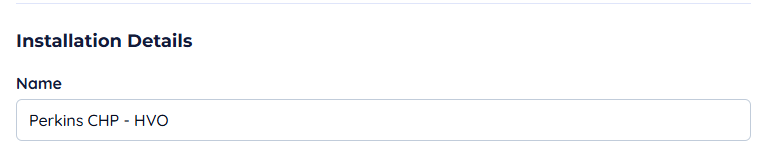
Name: Identifier for the installation.
Installation Design Life

Defines the operational period of the Engine.
- Installation Date: Date installation is complete.
- Decommission date (Optional): Date after which the installation is unavailable.
- Design Life (Optional): Number of years from installation date the installation will be available.
An installation date is required. If neither decommission date nor design life are present, the engine is considered installed until the end of the simulation.
Engine Details
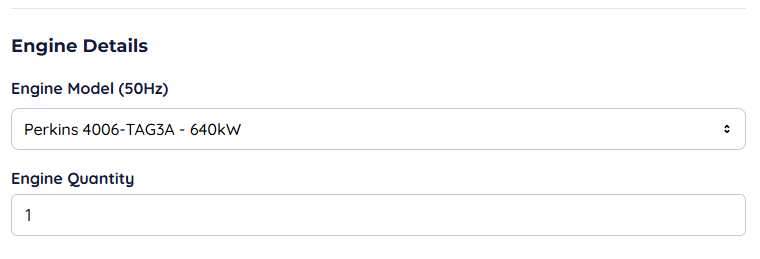
Engine Model: Select the engine from the drop-down menu. Engine Quantity: The number of engines. Treated in parallel as in Gas Engine Module.
Running Properties
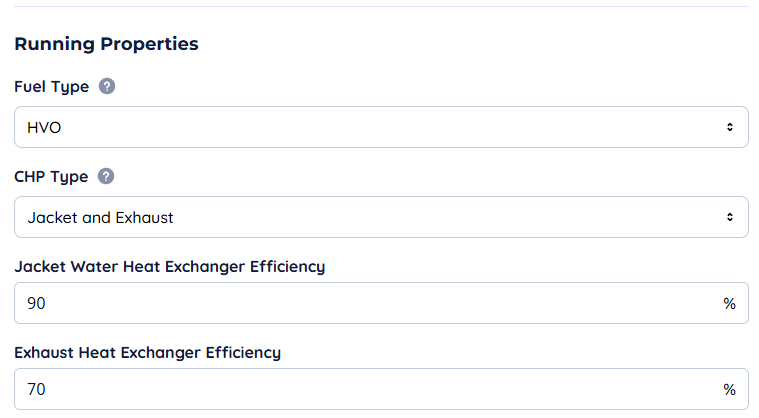
Fuel Type: EN590 (standard automotive diesel), HVO (Hydrogenated Vegetable Oil), UCO (Used Cooking Oil), UCOME (Used Cooking Oil Methyl Esters). CHP Type: No CHP, Custom Coefficient (coefficient of engine load), Jacket Water, Exhaust, Jacket & Exhaust.
Set Points
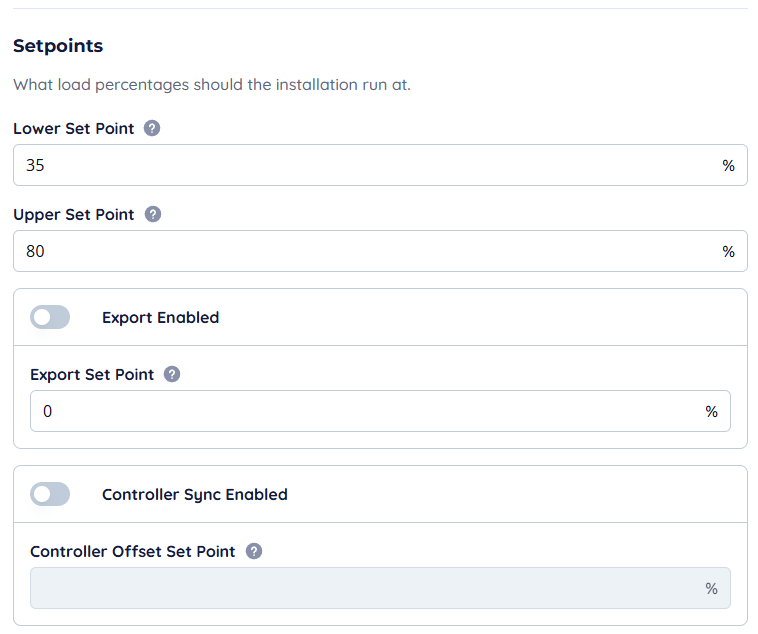
- Lower Set Point: Engines stop below this percentage of total capacity.
- Upper Set Point: Engines stop above this percentage of total capacity.
- Export Set Point (Optional): If enabled, installation never drops below this set point; excess is exported.
- Controller Sync Offset Set Point (Optional): Required if "Controller Sync" is enabled.
Operational Times and Maintenance

- Operational Times can be used to define the times when an installation is active.
- Maintenance is used to create shutdown periods to maintain assets or automatic costs based on the number of hours an installation has run.
These are explained in more detail in the Operational Times and Maintenance Section after Modules.
Specialisations and Use Cases
Integration with Other Systems
Engine generators complement renewable energy systems and provide essential grid services by:
- Providing reliable backup power during grid outages or renewable energy shortfalls
- Supporting renewable energy integration through rapid load following and frequency regulation
- Enabling microgrids and island mode operation with black-start capability
- Supplying both electrical power and thermal energy through combined heat and power configurations
Industrial and Commercial Applications
Reciprocating engine generators serve critical roles across diverse industrial and commercial sectors, each leveraging the technology's reliability and operational flexibility. Manufacturing facilities rely on engine generators for both emergency backup power and scheduled peak shaving operations, reducing demand charges while ensuring continuity of critical processes. The rapid startup capability, typically achieving full load within minutes, makes these systems invaluable for protecting sensitive equipment and maintaining production schedules.
Healthcare facilities represent one of the most demanding applications, where engine generators provide life-safety backup power for critical systems including operating theatres, intensive care units, and essential building services. The proven reliability and extensive service infrastructure of reciprocating engines make them the preferred technology for applications where failure is not an option. Many healthcare installations incorporate combined heat and power configurations, using waste heat for space heating, domestic hot water, and sterilisation processes.
Data centres increasingly deploy engine generators not only for backup power but also for peak shaving and grid services participation. The ability to start and synchronise with the grid within seconds enables data centres to participate in demand response programmes while maintaining the high reliability standards required for continuous operation. Advanced installations incorporate sophisticated load management systems that optimise generator operation based on electricity prices, grid conditions, and thermal loads.
Agricultural applications include dairy farms, grain processing facilities, and greenhouse operations where engine generators provide both reliability and economic benefits. Dairy farms particularly benefit from combined heat and power systems, using waste heat for milk cooling, barn heating, and hot water sanitisation. The ability to operate on renewable diesel fuels or biofuels produced on-site creates additional economic and environmental advantages for agricultural operations.
Commercial and Institutional Sectors
Educational institutions, government facilities, and commercial buildings utilise engine generators for emergency backup while increasingly exploring economic dispatch opportunities. Universities and large commercial complexes often incorporate trigeneration systems that produce electricity, heating, and cooling from a single fuel input, maximising overall energy efficiency and providing significant operating cost savings.
Retail and hospitality applications leverage engine generators to maintain operations during grid disturbances while reducing peak demand charges through strategic operation during high-cost periods. Shopping centres, hotels, and restaurants benefit from the waste heat utilisation for space conditioning and domestic hot water production, improving overall system economics.
Specialised Configurations
- Trigeneration Systems: Simultaneous production of electricity, heating, and cooling
- Microgrid Applications: Providing grid-forming capability for islanded operations
- Renewable Diesel Integration: Operation on sustainable fuel feedstocks
- Multiple Engine Configurations: Staged capacity deployment for improved part-load efficiency
Sensitive Parameters
Engine generator performance and economics depend on several critical parameters that require careful consideration during design and throughout the operational life. Fuel quality represents one of the most significant factors affecting both performance and maintenance requirements, with fuel specification variations directly impacting combustion efficiency, emission levels, and component longevity. The transition to renewable fuels such as HVO, UCO, and UCOME introduces additional complexity as these fuels may have different storage requirements, cold weather performance characteristics, and compatibility considerations with existing fuel systems.
Load factor and operational cycling patterns critically affect both fuel efficiency and maintenance costs. Reciprocating engines typically achieve optimal fuel efficiency at 75–85% of rated capacity, with significant penalties at very light loads below 30% capacity. However, unlike gas turbines, reciprocating engines can operate efficiently across a broader load range, making them suitable for variable load applications. Frequent starting and stopping increases maintenance requirements and reduces component life, particularly for larger engines where thermal cycling stresses are more significant.
Set point management requires careful optimisation to balance fuel efficiency, equipment longevity, and operational requirements. Operating below the lower set point can lead to wet stacking in diesel engines, carbon buildup, and reduced component life, while operation above optimal load ranges can cause excessive wear and reduced efficiency. The relationship between these parameters becomes particularly critical when using sustainable fuels, which may have different operating characteristics compared to conventional diesel fuel.
Economic Sensitivities
- Fuel Price Volatility: Diesel and alternative fuel costs can vary significantly, affecting operational economics
- Electricity Tariff Structures: Demand charges and time-of-use rates determine economic dispatch opportunities
- Maintenance Cost Escalation: Specialised service requirements and parts availability affect long-term costs
- Carbon Pricing: Environmental regulations and carbon taxes impact fuel choice and operational strategies
Technical Risk Factors
- Fuel Quality Variations: Contamination, water content, and fuel degradation affect performance and reliability
- Load Profile Matching: Mismatched load patterns can lead to inefficient operation and increased maintenance
- Environmental Compliance: Emission standards may require additional equipment or operational restrictions
- Cold Weather Performance: Low ambient temperatures affect starting reliability and fuel system operation
Regulatory and Environmental Considerations
- Emission Regulations: NOx, particulate matter, and other emission limits vary by jurisdiction and installation size
- Noise Restrictions: Acoustic requirements may necessitate sound attenuation equipment
- Fuel Storage Regulations: Environmental and fire safety codes governing fuel storage and handling systems
- Grid Interconnection Requirements: Utility interconnection standards and protection system coordination requirements
- Building and Fire Codes: Installation requirements for emergency power systems and fuel storage