Appearance
Heat Source Module
Module Overview
The Heat Source module in Encast provides comprehensive modelling capabilities for thermal generation systems including boilers, heat pumps, and resistive heating systems. This module enables accurate simulation of heat generation technologies across diverse applications from residential hot water systems to large-scale industrial process heating.
Heat sources represent critical infrastructure for providing thermal energy in buildings, industrial processes, and district heating systems. The module accounts for various heat source technologies, fuel types, efficiency characteristics, and operational constraints to provide accurate performance predictions and economic analysis throughout the system's operational life.
Unlike electrical generation systems, heat sources often operate with different efficiency characteristics and control strategies, requiring specific modelling approaches for thermal output, fuel consumption, and integration with building management systems. The technology diversity, from high-efficiency condensing boilers to advanced air-source heat pumps, makes this module essential for comprehensive energy system analysis across residential, commercial, and industrial applications.
Data Entry
Installation

Heat sources are added by selecting "Create new heat source installation".
Installation Details
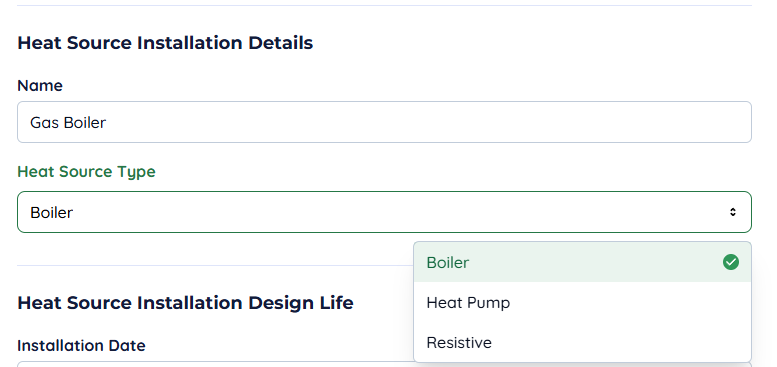
Name: Identifier for the installation. Heat Source Type: Boiler, Heat Pump, or Resistive.
Installation Design Life

Defines the operational period of the Heat Source.
- Installation Date: Date installation is complete.
- Decommission date (Optional): Date after which the installation is unavailable.
- Design Life (Optional): Number of years from installation date the installation will be available.
An installation date is required. If neither decommission date nor design life are present, the heat source is considered installed until the end of the simulation.
Boiler / Resistive Heater Parameters
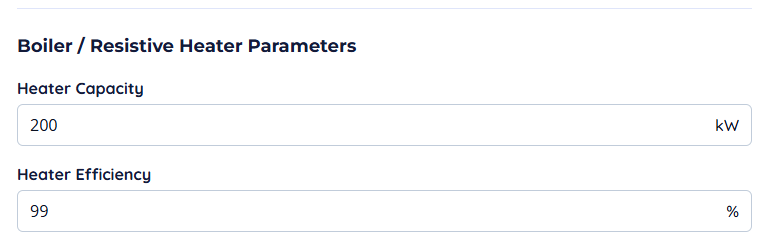
- Heater Capacity: Maximum heating capacity in kW.
- Heater Efficiency: Nominal efficiency as a percentage (Useful heat (W) / Input power (W)).
Modern Gas Boilers have >95% efficiency but check the one in question before entering details. A Resistive heater will always be >99% as they are simply a resistor using electricity to create heat.
Heat Pump Parameters
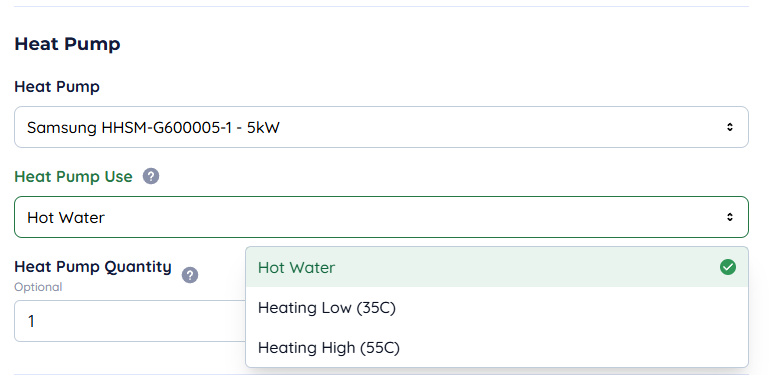
- Heat Pump Model: Select the heat pump model.
- Heat Pump Use: Hot Water (45℃ target), Heating Low (35℃, for radiators), Heating High (55℃, for residential hot water/anti-Legionella).
Operational Times and Maintenance

- Operational Times can be used to define the times when an installation is active.
- Maintenance is used to create shutdown periods to maintain assets or automatic costs based on the number of hours an installation has run.
These are explained in more detail in the Operational Times and Maintenance Section after Modules.
Specialisations and Use Cases
Integration with Other Systems
Heat sources complement renewable energy systems and support comprehensive energy strategies by:
- Providing reliable thermal energy during renewable energy shortfalls or peak demand periods
- Supporting renewable electricity integration through power-to-heat applications and thermal storage
- Enabling district heating systems with centralised thermal generation and distribution
- Supplying process heat for industrial applications with precise temperature control requirements
Residential and Commercial Applications
Heat sources serve critical roles across diverse residential and commercial heating applications, each leveraging different technologies based on building characteristics, fuel availability, and performance requirements. Modern residential installations increasingly utilise high-efficiency condensing boilers that extract additional heat from flue gas condensation, achieving seasonal efficiencies exceeding 95% while providing both space for heating and domestic hot water production.
Heat pump technology represents the fastest-growing segment in residential applications, offering superior energy efficiency through extracting ambient heat from air, ground, or water sources. Air-source heat pumps provide year-round heating and cooling capabilities with coefficient of performance values typically ranging from 2.5 to 4.5, depending on ambient conditions and system design. Ground-source heat pumps achieve even higher efficiencies by utilising stable ground temperatures, though requiring higher initial installation costs.
Commercial buildings leverage heat sources for space conditioning, domestic hot water, and specialised process applications. Large commercial installations often incorporate modular boiler systems that provide redundancy and improved part-load efficiency through staged operation. Combined heat and power integration enables simultaneous electricity generation and thermal supply, maximising overall energy efficiency while providing operational cost savings.
Healthcare facilities and hotels represent demanding applications where heat sources provide critical domestic hot water requirements with strict temperature control and anti-Legionella protocols. These installations often incorporate thermal storage systems and redundant heating capacity to ensure continuous availability of hot water services.
Industrial Process Applications
Industrial facilities utilise heat sources for diverse process heating requirements ranging from low-temperature applications below 100℃ to high-temperature processes exceeding 200℃. Steam generation represents a significant application area, where industrial boilers provide process steam for manufacturing operations, sterilisation processes, and building conditioning systems.
Food processing and pharmaceutical manufacturing require precise temperature control and validated heating systems that meet strict regulatory requirements. These applications often incorporate multiple heating zones with individual temperature control and monitoring systems to ensure product quality and regulatory compliance.
Chemical processing and manufacturing facilities leverage heat sources for reactor heating, distillation processes, and drying operations. The integration with heat recovery systems enables overall energy efficiency improvements by capturing waste heat from high-temperature processes for lower-temperature applications.
Specialised Configurations
- District Heating Systems: Centralised heat generation with thermal distribution networks
- Thermal Storage Integration: Coupling heat sources with thermal mass for demand management
- Hybrid Systems: Combining multiple heat source technologies for optimised performance
- Heat Recovery Applications: Integrating with waste heat recovery systems for efficiency improvements
Sensitive Parameters
Heat source performance and economics depend on several critical parameters that require careful consideration during design and throughout the operational life. Fuel quality and availability represent significant factors affecting both performance and operational costs, with natural gas, heating oil, electricity, and renewable fuels each presenting different supply reliability, price volatility, and environmental considerations.
Load factor and cycling patterns critically affect both fuel efficiency and equipment longevity. Heat pumps are particularly sensitive to ambient temperature conditions, with performance degrading significantly at low outdoor temperatures for air-source units. The relationship between heating demand patterns and heat source capacity sizing directly impacts both capital costs and operational efficiency, requiring careful optimisation to avoid oversizing penalties while ensuring adequate heating capacity during peak demand periods.
Control system integration and thermal distribution design significantly influence overall system performance. Poor hydraulic balancing, inadequate insulation, or improper control sequences can dramatically reduce system efficiency regardless of heat source performance characteristics. The integration with building management systems and thermal storage becomes particularly critical for optimising operational costs and managing peak demand periods.
Economic Sensitivities
- Fuel Price Volatility: Natural gas, heating oil, and electricity costs can vary significantly, affecting operational economics
- Electricity Tariff Structures: Time-of-use rates and demand charges impact heat pump operational strategies
- Maintenance Cost Escalation: Specialized service requirements and component replacement affect long-term costs
- Carbon Pricing: Environmental regulations and carbon taxes influence fuel choice and technology selection
Technical Risk Factors
- Ambient Temperature Dependence: Heat pump performance varies significantly with outdoor conditions
- Fuel Supply Reliability: Natural gas supply interruptions or heating oil delivery constraints affect availability
- System Integration Complexity: Poor design of thermal distribution systems reduces overall efficiency
- Thermal Load Matching: Mismatched capacity sizing leads to inefficient cycling and increased maintenance
Regulatory and Environmental Considerations
- Emission Standards: NOx and particulate matter limits for combustion-based heat sources
- Efficiency Regulations: Minimum efficiency requirements for new installations and replacements
- Refrigerant Regulations: Heat pump refrigerant phase-out schedules and environmental impact requirements
- Building Codes: Installation requirements for heating systems and fuel storage
- Energy Labelling: Performance disclosure requirements for heat source equipment